This catalog summarizes the names and explanations of EMC terms for electromagnetic compatibility that EUTTEST has compiled.
Common Mode Interference: Interference currents on two conductors with equal amplitude and in the same direction are called common mode interference. When the interference current passes through the conductors, a common mode voltage will be generated. Common mode interference can be tested using an artificial power network.
The common unit of electromagnetic nuisance is usually expressed in "decibels - dB", which is originally defined as the ratio of two powers. Power, voltage, current, and field strength can all be expressed in dB-dB.
Spectrum from low frequency to high frequency is divided into different frequency domains such as RF, microwave, millimeter wave, etc. depending on the test frequency.
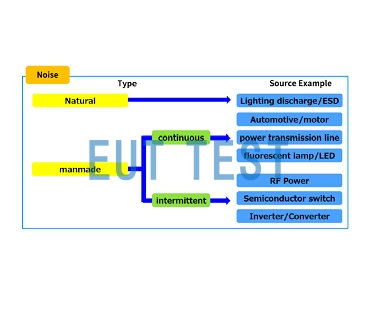
When an electronic device or product is in operation, due to a variety of factors, the product's voltage, current, signal, etc. will contain many unwanted noise components, many of which may be the cause of product failure or performance degradation, which is related to the hardware R&D designers...
A power delivery system is also known as a power delivery system or power supply system, or PDS for short.The impedance of a PDS is defined as the power source traveling from the power module, generally through the circuit boards, packages, and interconnections within the chip, and finally to the transistors....
Synchronous switching noise is defined as when multiple I/O ports of a chip are flipped in the same direction at the same time, such as from 1 to 0, the current consumed by the buffers of multiple I/Os at the same time is superimposed on the power and ground pins to generate...
The S-parameter is a parameter that describes the characteristics of a high-frequency network and is an important parameter for signal integrity, similar to the Z-parameter and Y-parameter in circuit theory. But [...]
A transmission line is a connection that is capable of propagating an electromagnetic field signal in the longitudinal direction. When the physical dimensions of the device or the dimensions of the electrical connection are comparable to the wavelength of the signal, transmission line theory is needed to analyze it. Attention needs to be given to the characteristic impedance of the transmission line, the reflection coefficient...