
Common units of electromagnetic nuisance - decibels - dB
Electromagnetic nuisance of the common unit is usually used "decibel - dB" to express the original definition of the decibel as the ratio of the two power. The following chart shows the attenuator's input and output port power change of 6dB, 20/5 = 4 times, indicating that the power attenuator 6dB is also 4 times.
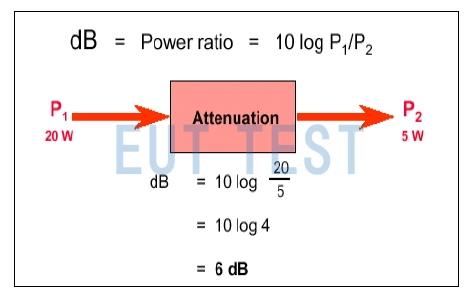
The change in input and output power of the attenuator is expressed in decibels
Power decibel representation:
The unit of power is usually expressed in dBm, dBm being the value of power relative to 1mW:
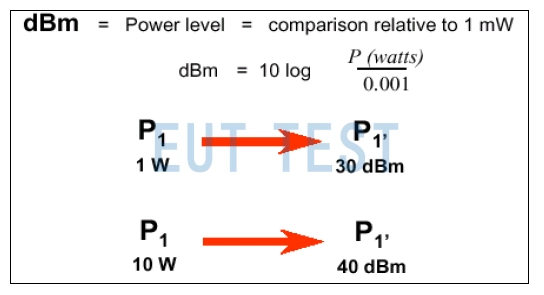
Power in dBm for 1W and 10W
Voltage decibel representation:
The magnitude of the voltage is usually expressed in dBuV, dBuV being the value of the voltage relative to 1uV.
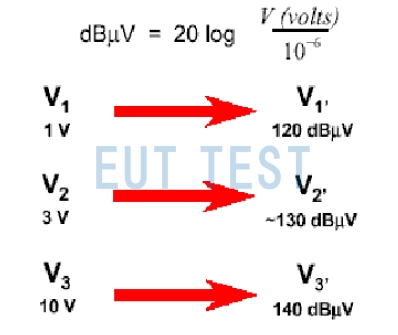
1V, 3V, and 10V express the voltage in dBμV, respectively.
Current decibel representation:
The magnitude of the voltage is usually expressed in dBuA, dBuA being the value of the current relative to 1uA.
The field strengths are expressed separately:
For radiated nuisance it is usually measured by the magnitude of the electromagnetic field in V/m. The unit usually used is dBuV/m.
Why do we use dB for electromagnetic nuisance?
When we use 120dBμV for a 1V voltage, you might think that makes sense, but let's calculate again how many dB is a 0.001V voltage equal to?
0.001V = 20*log(0.001*1,000,000) = 60dB;
As can be seen from the above equation, 1V becomes 0.001V by a factor of 1,000; 120dBμV becomes 60dBμV by only a factor of two.
So in decibels dBelectromagnetic harassmentThis allows you to display a larger amount of change with a smaller value.
Now the EUTTEST website has launcheddB Online Free Calculatorpage, you can quickly convert different dB units directly.
- Created on: 2025-05-01 18:12:42 ;
- Last modified on 2025-07-18 18:02:21 ;