

Introduction:
Electromagnetic compatibility EMC industry in full swing, especially in 2025, GB 4343-2024, GJB151C and other China's new EMC standard release, all means that our country's quality certification management department is paying more and more attention to the domestic products of electromagnetic compatibility EMC performance, if you as an EMC engineer, you should firstly learn to do the product testing according to the requirements of the new standard, and then to If you, as an EMC engineer, should first learn to do product testing according to the requirements of the new standards, and then learn to do EMC analysis of your own products with EMC simulation software in the new year to improve their competitiveness in the EMC industry.
Current EMC Engineer Employment Background:
Whether it is automotive electronics, civil products, industrial equipment, integrated circuits industry, by the National Standards Committee for their customized EMC standards are the basic requirements for EMC engineers, engineers need to strictly follow the latest EMC test standards to do the certification testing of the product; in addition, if you search for "EMC Engineer" from the job site In addition, if you search for "EMC Engineer" from the recruitment website, we will find that most of the companies no longer purely require EMC engineers to doEMC testingThe company has also learned to use EMC simulation software to do RF on products prior to development,ICThe EMI analysis between PCBs.
However, only in accordance with the standard EMC test is the basic work of most EMC engineers, they can not even solve the radiation interference exceeds the standard, static electricity and surge pulses to break the MCU chip and other common EMC problems, not to mention in the product is not produced before the EMC pre-simulation, in advance to understand the impact of the different product structure, PCB layout design on the final EMC performance.
Define the importance of EMC simulation:
We covered that in another article " The relationship between the production process of electronic products and EMC testing", illustrates that test rectification and PCB design simulation at the R&D stage will reduce the cost of the entire product production process. If we only consider EMC testing after the product is manufactured, you and your company will need to spend a huge amount of money, time, and effort to solve the EMC problem of the product being measured and reported.
Therefore, it is beneficial for the EMC engineers themselves as well as the manufacturers to use EMC simulation software to analyze the structure and PCB of the products in advance, and to solve most of the EMC problems before the products are produced. Here's what are the EMC simulation software for EMC now?
Electromagnetic compatibility EMC simulation software:
Ansys
Ansys offers three electronic EMC simulation software programs including HFSS, Slwave, and EMC plus:
Ansys HFSS
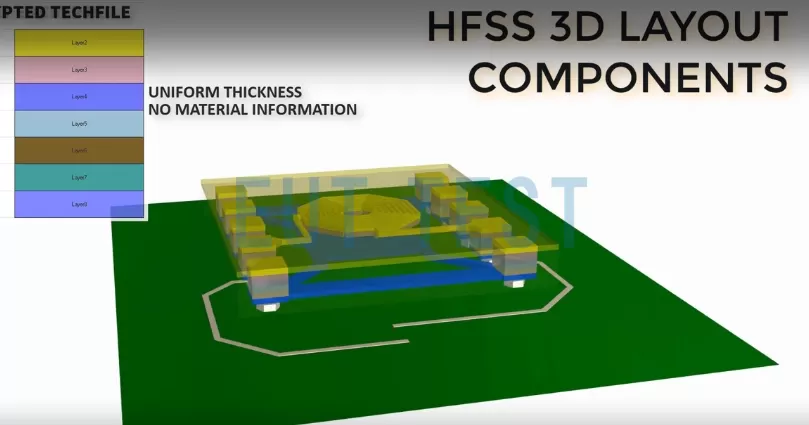
Ansys HFSS 3D Analysis
Ansys HFSS is 3D electromagnetic (EM) simulation software for designing and simulating high-frequency electronics such as antennas, antenna arrays, RF or microwave components, high-speed interconnects, filters, connectors, IC packages, and printed circuit boards. Engineers worldwide use Ansys HFSS software to design high-frequency, high-speed electronics in communications systems, advanced driver assistance systems (ADAS), satellites, and Internet of Things (IoT) products.
Basic functions of HFSS:
- Antenna Design Toolkit
- Radar pre/post-processing
- Frequency-time domain finite element method
- Hybrid FEM/IE/SBR+ solver
- New: conforms to ISO-26262
- 3D Layout ECAD Process
- *SBR+ Accelerated Doppler Processing
- Integral equation (MoM)
- In-Memory Matrix Solver
- 5G post-processing
- Parallel initial 3D meshing
- SBR+ for large-scale EM
- Multiple Shrinkage Solver
Ansys Slwave

Ansys Slwave Electrothermal Analysis
SIwave helps you model, simulate, and verify high-speed channels and complete power delivery systems typical of modern high-performance electronics. It accurately extracts multi-gigabit SERDES and memory buses to provide product compliance for a wide range of designs.SIwave's full-wave extraction of complete power distribution networks (PDNs) enables you to validate noise margins and ensure that impedance profiles are met through automated decoupling analysis in low-voltage designs.
Basic functions of Slwave:
- Layout and Geometry Import
- IBIS and IBIS-AMI SerDes Analysis
- Impedance and crosstalk scanning
- EMI Solutions
- Electrothermal analysis
- Virtual Compliance
- Multi-domain system modeling
- high performance computing
- Automatic decoupling capacitors
- Electromigration analysis
Ansys EMC Plus
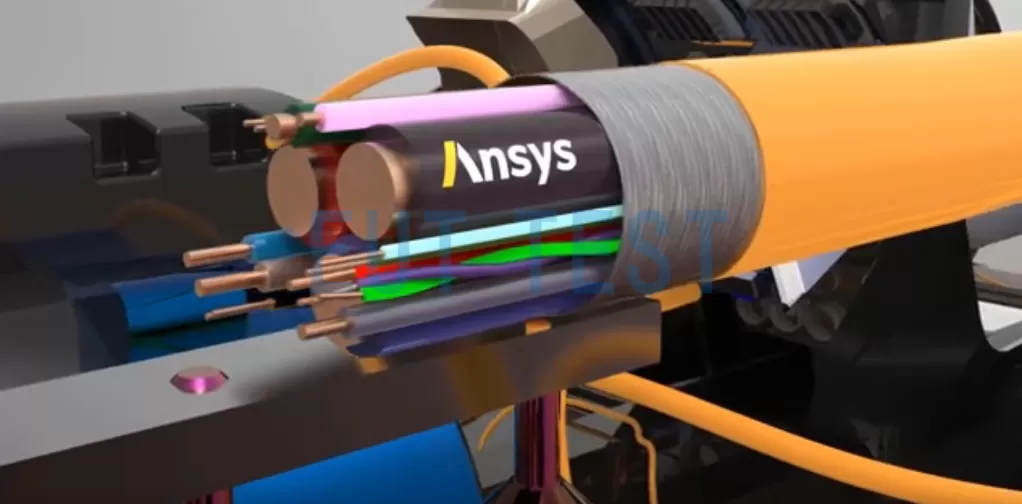
Ansys EMC Plus analyzes cable models
Ansys EMC Plus is a platform-level EMC electromagnetic modeling and simulation software.Ansys EMC Plus specializes in analyzing lightning induced electromagnetic (EM) effects on large platforms as well as cable EMI/EMC issues on aircraft and automotive platforms in support of EMC certifications.Ansys EMC Plus supports EMC certification by performing system design evaluations on wire harness models for aerospace, automotive, military, oil and gas, consumer electronics, and energy sectors, also analyzes cable cross-section electrostatic simulation and analysis of hybrid transmission circuit boards to support workflows from design to validation.Ansys EMC Plus supports EMC certification by performing system design evaluations on harness models for aerospace, automotive, military, oil and gas, consumer electronics, and energy sectors.
Basic Functions:
- time-domain finite-difference method
- Hybrid transmission line solving
- Support for Ansys HPC
- Supports multi-level masking
- Inductive and Capacitive Simulation
- Ansys SpaceClaimTM includes
- thin surface algorithm
- Ansys HFSS Integration
CST Studio Suite
CST Studio Suite® is a high-performance 3D EM analysis software package. CST software is used to simulate electromagnetic fields across the entire electromagnetic spectrum. It allows engineers to experiment with virtual prototypes at the earliest stages of the design process to compare the performance of different configurations and optimize the product. Simulation reduces the number of physical prototypes required and shortens the development process, resulting in lower costs and shorter time to market. Products can be simulated as part of a real system to analyze their installed performance and verify compliance with legal electromagnetic compatibility (EMC) and exposure limits, avoiding time-consuming redesigns or costly recalls.
The CST Studio Suite includes electromagnetic field solvers for applications across the entire electromagnetic spectrum in a single user interface. The solvers can be coupled to perform hybrid simulations, giving engineers the flexibility to analyze entire systems consisting of multiple components in an efficient and straightforward manner. Co-design with other SIMULIA products enables EM simulation to be integrated into the design flow and drive the development process from the earliest stages.
Common topics in electromagnetic analysis include antenna and filter performance and efficiency, electromagnetic compatibility and interference (EMC/EMI), human exposure to electromagnetic fields, electromechanical effects in motors and generators, and thermal effects in high-power equipment.
CST five major functional modules:
- Electromagnetic Simulation Solver
- Electromagnetic Design Environment
- automatic optimization
- Electromagnetic system modeling
- Workflow integration
CST Utilization:
- Antenna Design and Simulation
EM simulation tools are invaluable throughout the antenna development and integration process. They help create functional antenna designs, improve them to meet requirements, and evaluate their performance and RF exposure after installation.The SIMULIA suite provides antenna engineers with the tools they need for a variety of applications.
- EMI simulation
Control of electromagnetic interference (EMI) is a critical aspect of the design and manufacture of electronic equipment. Products must comply with internationalElectromagnetic compatibility (EMC) standardsto ensure that electromagnetic emissions are within permissible limits and that these devices are not susceptible to external interference. Electromagnetic simulation helps to identify potential problems and can simplify the development process in terms of certification.
- Microwave/RF Filter Component Design Simulation
CST Studio Suite technology offers a variety of electromagnetic solvers for simulating microwave and RF filters and components. The time-domain solvers are well suited for broadband traveling wave components, while the frequency-domain solvers are ideal for highly resonant structures such as bandpass filters. Special features include moving meshes and model downscaling methods for accurate and fast simulations. Waveguide ports help excite transmission lines, and system assembly modeling simplifies complex device modeling.Fest3D's solver technology is effective for simulating waveguide structures.
- Bioelectromagnetic Field Simulation
- Electromagnetic compatibility simulation
- Signal and power integrity simulation
- Low Frequency Electromagnetic Field Simulation & Motor Simulation
SIMULIA's versatile tools meet the needs of users in different industries, ensuring accuracy in critical applications such as medical device and magnet design. Advanced modeling capabilities allow in-depth analysis of devices with permanent magnets or superconducting coils. Customized interfaces help users simulate and enhance high-efficiency motors and generators. Electromagnetic simulation helps create sustainable machines with optimal performance.
- Optical device simulation
CST Studio Suite skillfully and efficiently simulates fluctuation behavior at optical frequencies. Automatically import links to photonic device layout tools to easily generate 3D simulation models. Material library contains optical frequency material models. Post-processing templates allow calculation of standard industry metrics. Large electrical components can be simulated with high-performance computing options.
- Particle dynamics simulation
The SIMULIA simulation portfolio offers a wide range of solvers for simulating devices with free-moving particles and electromagnetic fields. It includes technologies from CST Studio Suite and Opera. Charged particle dynamics simulations involve analyzing particle emission, electrostatic acceleration, static magnetic focusing, and high-energy relativistic equations of motion.
Simcenter
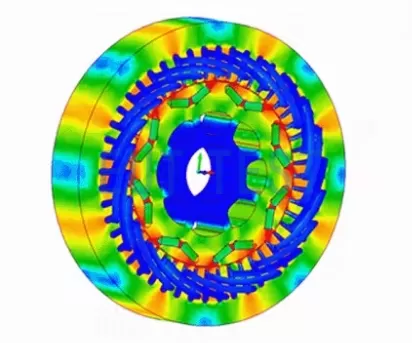
Simcenter Simulation Motor Coil
Simcenter MAGNET simulation software helps you improve efficiency, ensure compatibility, and guarantee performance in complex, noisy environments.Simcenter MAGNET is a powerful EMF simulation solution for performance prediction of motors, generators, sensors, transformers, actuators, relays, or any component with permanent magnets or coils.
Simulation of physical properties of electromagnetic devices
Simcenter MAGNET has the capability to accurately model the physical properties of electromagnetic devices. This includes the ability to model manufacturing processes, temperature-dependent material properties, magnetization and demagnetization modeling, and vector hysteresis modeling.
Simcenter MAGNET also features a built-in motion solver with six degrees of freedom. It allows accurate modeling and analysis of complex problems such as magnetic levitation or complex motion. This is achieved through a unique intelligent re-meshing technique.
Exploring possibilities through simulation automation
An efficient design process requires tools that can be customized to the workflow. simcenter MAGNET includes advanced scripting capabilities for flexible workflow automation.
Using the fully parametric CAD capabilities of Simcenter MAGNET will increase the efficiency of your simulations. In particular, models that typically require extensive manual processes, such as those that include extensive calculations for a variety of magnets with different sizes and many air gaps.
Maintains integration with circuit-to-system level modeling
System-level (1D) or model-based (2D axisymmetric, 2D translational, and full 3D) analyses require accurate subcomponent models to account for interactions and local transients that affect overall system behavior.
Simcenter MAGNET includes features such as native circuit simulation, co-simulation connectivity, and export of 1D system models for Simcenter Flomaster, Simcenter Amesim, and other platforms.
A range of dedicated solvers (time and frequency based, linear and nonlinear, finite and boundary element) provide a transformative CAE process, with simulations ranging from rapid initial analysis to final validation of inherent realism.
Basic Functions:
- AC electromagnetic simulation
- Advanced electromagnetic material modeling
- Electric field simulation
- Electromagnetic Motion Simulation
- transient electromagnetic simulation
- Steady state and transient temperature distribution
EMCOS
EMCoS Studio
Simulate in EMCoS Studio and find solutions to a wide range of EMC problems.EMCoS Studio provides a user-friendly interface for the simulation of complex EMC problems. Models can range from simple test setups to complex real-life environments.
EMCoS SimDAT
EMCoS SimDAT is a powerful tool for simulation data analysis and post-processing of results. It can load computational models in a 3D view and analyze the results using advanced 2D and 3D post-processing tools.EMCoS SimDAT includes special extensions for human exposure analysis and advanced virtual spectrum analyzer tools for digital signal processing.
Remesh
Use ReMesh to prepare vehicle, aircraft or ship models for EM simulations based on more detailed representations.ReMesh allows performing efficient and fast model coarsening, reducing the number of discrete elements and maintaining the original shape.
Cadence (company name)
Do hardware developers know, Cadence is a circuit board and PCB layout design software, now the software added a few EM simulation module:
Clarity 3D Solver EM simulation solver:
Clarity 3D Solver utilizes defined geometry and material information from Cadence Allegro® PCB or IC designs and Virtuoso system design platforms to obtain high-speed/high-frequency electrical behavior of PCB, package, and IC structures. By providing a virtually unlimited capacity of EM analysis that can cover a wide range of manufacturing technologies in today's heterogeneous systems, designers can solve larger problems without adding the time, cost and potential errors associated with exporting, partitioning, simplifying and reassembling analysis results from a design.The Clarity true 3D EM field solver enables designers to avoid error-prone partitioning methods and to increase the speed of simulation while maintaining the gold standard accuracy while increasing simulation speed by a factor of 10.
Cadence Sigrity Signal and Power Integrity Simulation
Cadence Sigrity™ SI/PI technology provides powerful, accurate signal integrity (SI) and power integrity (PI) planar 3D EM simulations that address the scale and scalability challenges of today's leading 5G communications, automotive, exascale computing, and aerospace and defense industries. The software is available for all major PCB and IC package design platforms, including Cadence's Allegro PCB, Allegro Package and Integrity 3D-IC design platforms. It provides high-speed system designers with comprehensive end-to-end SI/PI analysis, in-design interconnect modeling, and power delivery network (PDN) analysis for PCB and IC package design. Working in a unified, integrated and collaborative design environment, design engineers are more productive, able to meet compressed schedules and bring products to market on time and within budget.
EMX Planar 3D Solver High Frequency and High Speed IC EM Simulation
EMXPlanar 3D Solver is an EM simulator for high frequency and high speed IC design. It enables designers to accurately simulate complex layouts while reducing design cycle time. The solver is optimized for analyzing passive devices on silicon, primarily planar conductors and small vias such as on-chip interconnects. It also has an extensive library of process design kits (PDKs) from all major foundries. This combination provides a fast and accurate process. emx solver seamlessly integrates with the Virtuoso platform and Virtuoso Studio
Altium Designer
Altium Designer is as well known as Cadence for circuit PCB design and development, and the biggest need for AD software is listed here because Altium Designer offers a comprehensive set of analysis tools covering circuit performance, signal integrity, and DC power systems. Easily perform circuit simulations and test your ideas as you create your design, with support for analog PSpice, LTspice and xSpice in digital format.
- Perform any basic circuit analysis
- Design and simulation in a single environment
- Analog component tolerances
- See every detail of the simulation results
- Getting Ready-to-Use Components with SPICE Models
The most interesting feature of the AD software is that it allows you to do 3D-MID design in 3D view right within the software. 3D-MID technology combines circuits with three-dimensional mechanical parts. In fact, there is no electromagnetic simulation available. But we need the software to design schematics and PCBs, and then import them to be analyzed in the previously mentioned software such as Ansys.

Altium Designer 3D-MID Design
Above is the basic introduction of common EMC EMC simulation software, the most important thing is to choose the most suitable product software according to their functions, and then learn and make progress in your spare time.