Introduction to Conical Covers:
The conical shield is an EMC test fixture for luminaires mentioned in CISPR 15 and Appendix A.1 of GB 17743. Both of these standards are foundational EMC standards for luminaire products. In previous versions of the luminaire EMC standards, tests were often conducted using the configuration shown in the figure below:
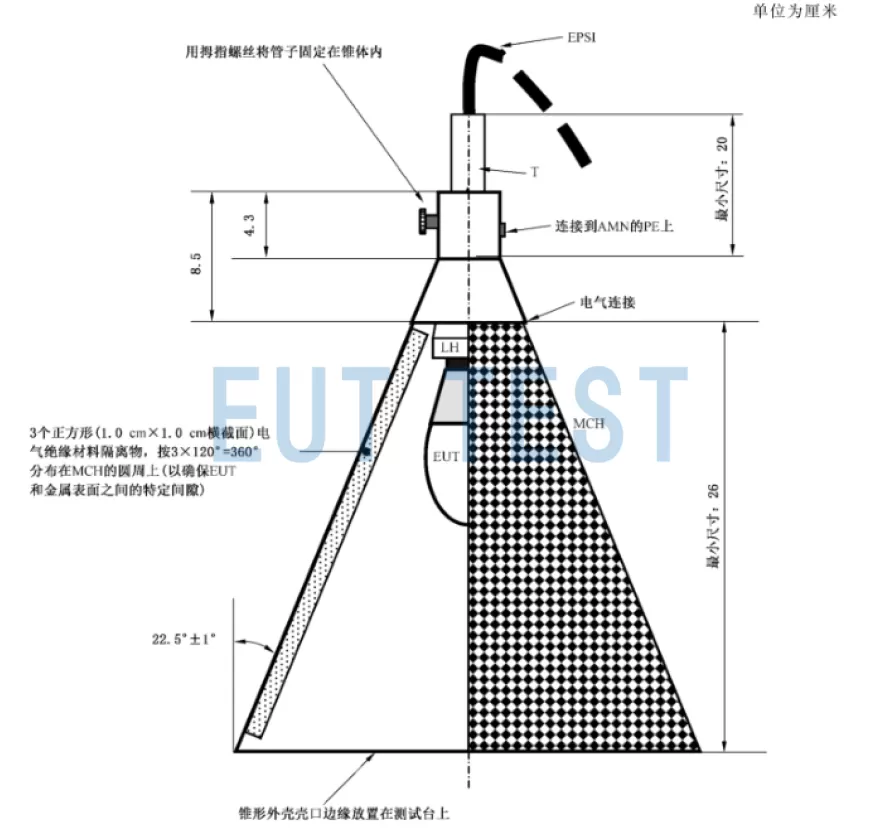
Requirements for the Arrangement of Conical Shielding Cages in the Previous Versions of CISPR 15 and GB/T 17743
As shown in the image above, single-ended self-ballasted lamps, such as LEDs, need to be installed in a suitable lamp holder inside a conical shade. These shades typically come in various sizes, such as E27, E14, and E12. We offer this conical shade product along with compatible lamp holders for you to choose from. For more details on available lamp holders, please seeConical Cover | Schwarzbeck | 9kHz-30MHz | CISPR15 ELV Luminaire Conical Cover. Our current priority is to review the latest EMC conducted emission test requirements for luminaires, which introduce new installation requirements for conical shields. We need to reconfigure the EMC laboratory in accordance with these requirements to ensure compliance with and standardization against the latest standards, thereby improving the reproducibility of EMC testing.
New requirements for the installation of conical covers under the new standard:
Note: This article provides instructions specifically for modifying conical covers and does not implyCISPR15This is the only change made to the latest standard. If we have other similar articles, we will note within them that they apply to the CISPR 15-2024 standard.
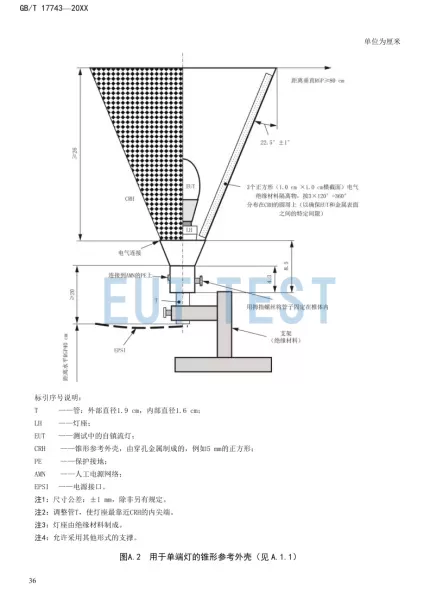
CISPR 15-2024 now includes a new requirement that the conical shield be mounted on a 40-cm-high stand, but GB/T 17743-2026 has not yet been officially released. and the draft version of GB/T 17743-2026 has also adopted similar installation requirements for the conical shield in line with CISPR 15. The new test setup diagram for conducted emissions testing of self-ballasted lamps is shown below:
GB/T 17743-2026 Test Setup Diagram for Conducted Emissions of Self-Ballasted Lamps
Basic Requirements:
As can be seen from the image above and the cover image of this article, the new standard has changed the orientation of the conical hood, which was previously placed on a metal surface.Horizontal Ground Coupling Plate (GRP)Previously, the conical opening faced the floor, but now it faces upward, and a custom bracket is required to position the conical hood 40 cm above the GRP. This requirement differs significantly from the previous version of the standard; therefore, EMC laboratories still using the old test method should adopt the new test setup as soon as possible to conduct conducted disturbance testing on luminaires.
In addition, the standard specifies certain distance requirements; you can use these requirements as a guide for detailed layout planning:
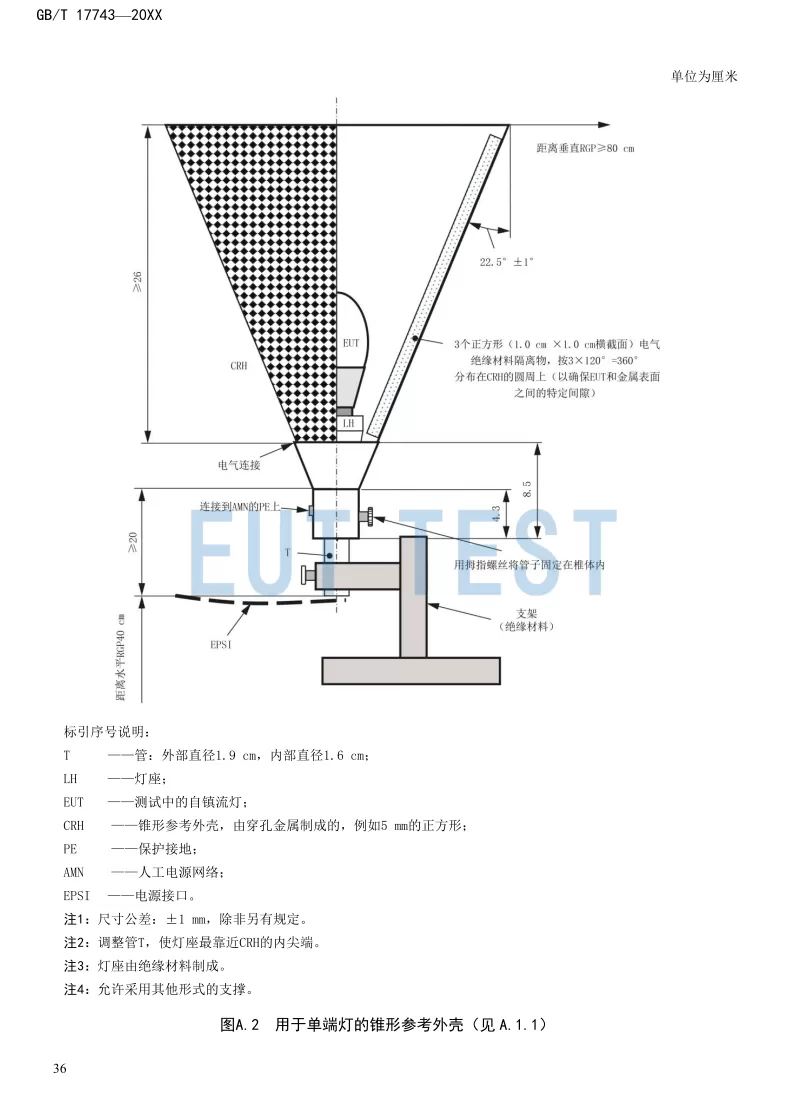
The lamp tube shall be mounted in a suitable lamp holder and installed in the conical reference enclosure shown in Figure A.2. The conical enclosure shall be placed on a table such that the closest part of the cone is 40 centimeters from the horizontal reference ground plane (RGP) (see Figure B.3). The horizontal RGP is fixed at a distance of 40 cm from the tube (T). The power supply interface (EPSI) is arranged horizontally to maintain a fixed distance from the horizontal RGP. The vertical RGP (if present) shall be ≥ 80 cm from the edge of the apparatus. The measurement of the lamp in the reference enclosure shall be similar to that of a luminaire with the optical window positioned as shown in Figure B.3. Self-ballasted lamps with a GU10 base (IEC 60061-1) shall be mounted in a fixture with a conductive hose clamp that contacts the housing (conductive or non-conductive) near the edge of the GU10 lamp, as shown in Figure A.5. The width of the hose clamp shall be (9 ± 1) millimeters. The conductive hose clamp, together with a suitable lamp holder, shall serve as the reference luminaire for GU10 lamps.
Connect the power cord with the tapered housing or GU10 lamp hose clamp terminal to AMN It should be 1 meter long. The hose clamp on the tapered metal housing or GU10 lamp should be grounded to AMN.
Single-cap self-ballasted lamps with unusual shapes that cannot be fitted into a conical test enclosure shall be measured using a reference enclosure (reference luminaire) that meets the main system requirements specified in 6.4.1.
How can we meet the requirements of the new standards?
For EMC laboratories that have already purchased a conical shield, we only need to purchase a mounting bracket in accordance with the standard requirements.ACC-STAND, Test Your Conical Hood Equipment Conical Cover Install it on the mount, adjust the mount's height, and it will meet the requirements of the latest CISPR 15 standard.
For EMC laboratories that have not conducted conical antenna tests, all you need to do is purchase a conical antenna and a mounting bracket to meet the latest standard requirements.
In summary, the new standard’s requirements for conical hoods are actually very straightforward; you simply need to modify your test setup according to the two recommendations provided above.