Introduction:
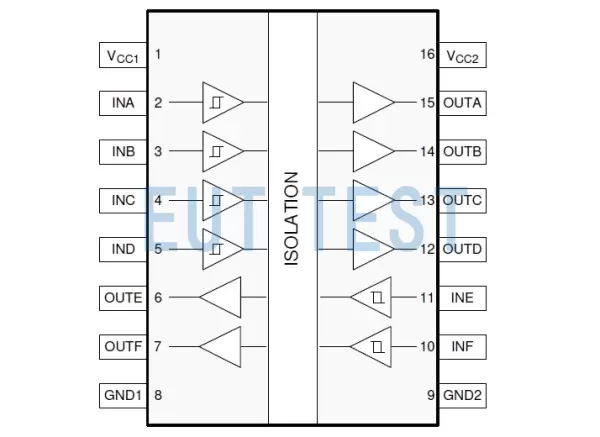
Nowadays, many digital isolator products are based on IEC60664-1\ DIN EN IEC 60747-17 (VDE 0884-17)\UL1577 to do the insulation certification test, the following we excerpted some of the common digital isolator products on the market parameter table, for customers to refer to and design their own products should be completed which insulation test items and test methods.
Overall all test items and test methods are selected based on the certification standard, so we should first select the test standard and then select the test items.
Insulation test standards for common digital isolator products:
IEC60664-1 Insulation test items and test methods:
“Reminder: swipe tables left and right”(1), the listed test value is only a common indicator, the specific value depends on the chip package type, different packages are different indicators.
DIN EN IEC 60747-17 (VDE 0884-17) Insulation test items and test methods:
We have already covered this standard in detail in another post:Certified Test Programs for Digital Isolators and OptocouplersThe
Suitability: This digital isolator is only suitable for safe electrical insulation within the safety ratings. Compliance with safety ratings should be ensured with the aid of suitable protective circuitry.
“Reminder: swipe tables left and right”VTEST = 1.2 x ViOTM, t = 1 second (100% production test)
(apparent charge)
Vpd(m) = 1.875 x VIORM, Tm = 1 s (method b1)
Vpd(m) = Vini, Tm= Tini= 60 seconds (method b2).
/
(1) The creepage distances and clearances shall meet the requirements in the application-specific equipment isolation standards. Care should be taken to maintain the board design creepage distance and clearance so that the mounting pads of the isolators on the printed circuit board do not result in a shortening of this distance. Under certain circumstances, the creepage distances and clearances on the printed circuit board become equal. Insertion of a bevel or rib on the printed circuit board or simultaneous application of a
These two technologies can help improve these specifications.
(3), test in air to determine the surge immunity of the package.
(4), testing in oil to determine the inherent surge immunity of the barrier.
(5), the apparent charge is the electrical discharge caused by partial discharge (pd); we recommend the use ofHT-9464M Device Measurement.
(6), all pins on each side of the isolation layer are connected together to form a two-pin device.
UL 1577 Insulation test items and test methods:
“Reminder: swipe tables left and right”Note: For sine wave signals, the RMS value is equal to the peak value divided by the root sign 2; the peak value = RMS * 1.414; and the peak-to-peak value is equal to twice the peak value.
The above is a list of three common standards for insulation certification test items for digital isolator products, and of course there are other test standards such as “What standards to look for in an optocoupler or digital isolator for safe electrical isolation”,“What isolation safety approvals are required for digital isolators or optocoupler chips”。
Test specifications are determined based on the product package:
In the actual digital isolator certification process, we not only pay attention to the test standards, but also according to different product package specifications, as well as the certification of the country category to determine the different digital isolators need to do what insulation test items, as well as the need to do what kind of voltage level.
Note: The following table (DBQ, DW lamps are product package specifications)
“Reminder: swipe tables left and right”62368-1 and IEC 60601-1
62368-1
DBQ-16: Basic insulation, altitude ≤ 5000 m, tropical climate, max. operating voltage 400 VRMS
As can be seen from the above table, the product needs to be certified by which country, it determines the subsequent basis of standards and certification requirements, but also with the product package has a relationship, so only this article for the majority of customers to provide a reference to the specific test items and indicators still need to be confirmed by the customer themselves.
 What does the DIN VDE V 0884-11:2017-01 standard mean for digital isolator chip design?
  IEC 60747-17 Safety certification test items for digital isolators
  DIN V VDE V 0884-11 (VDE V 0884-11): 2017-01 Certification Test Program Overview