
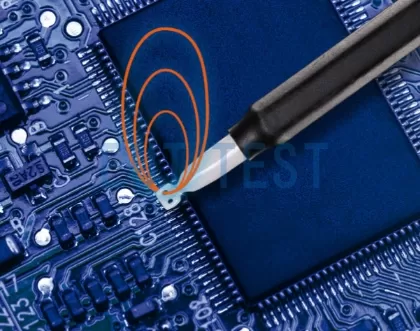
Introduction:
There are a lot of various test frequencies and shapes of EMC near-field probe on the market, many customers contact EUTTEST in the consultation near-field probe do not know how to choose the near-field probe suitable for their needs, we all know that the role of the near-field probe is to detect and solve the problem of EMC radiated emissions interference exceeds the limit, this article from the near-field measurements and far-field measurements of the principle and difference, explain the use of near-field probe Measurement of the necessity of using near-field probes, and were introduced to the magnetic field near-field probe and electric field near-field probe measurement principle, but also provides some recommended near-field probe selection, I hope that how to choose the near-field probe have questions about the customer to help. How you read this article is still not clear how to select, contact us for more information.
Before we introduce near-field probes, we need to understand the difference between near-field and far-field testing before we can understand why near-field measurements can replace far-field measurements.
Difference between near-field and far-field measurements:
Measure the effect of distance on the radiation field:
The field shapes of the different radiation sources are not the same, but they all prove the principle that whenever there is a radiation disturbance it decreases with distance. So near-field measurement and far-field measurement will get different test results respectively. The National Science and Technology Nomenclature Validation Committee Affairs Center ofElectrical Engineering Terminology Validation CommitteeSeveral different sources of non-ionizing radiation were released:
- When the source of radiation is a pointpoint source of radiationThe radiated field is a spherical emanation, that is, an omnidirectional antenna, at which point we can measure the radiation value at any distance from the point source of radiation, the difference is simply that the interference level is large in the near distance, while in the far distance the interference level gradually decreases.
- When the source of radiation is a linelinear radiation sourceThe radiation field is cylindrical and differs from a point source in that there is no vector field parallel to the cable, whereas for the direction perpendicular to the cable, the interference level still decreases logarithmically with increasing measurement distance.
- When the source of radiation is a surfacesurface radiation sourceThe radiation field is always pointing vertically from the plane of the radiation source to the outside space, and the interference level still decreases logarithmically with increasing measurement distance.
Extended reading: two effective methods to attenuate EMI radiation interference
Near-field measurements:
Near-field measurement is to measure the size of the interference level in a position closer to the radiation source, we can generally choose to use near-field probes, current probes and other auxiliary tools with spectrum analyzers or oscilloscopes to complete the measurement of radiation interference. When the emission level of the radiation source is very large, the near-field can be measured to a larger value, so we have to add a pulse limiter in the back end of the near-field probe to protect our receivers; and when the emission level is very small, the near-field measurement can be measured to the far-field measurements can not be obtained data, because at this time, the radiation level in the far-field is very small.
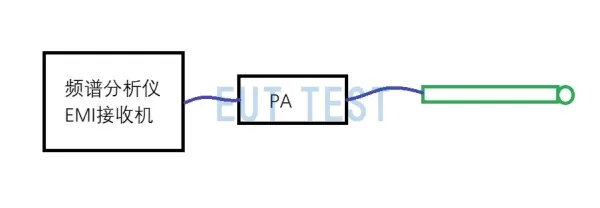
The disadvantage of near-field measurements is that there is no guarantee that the position of each measurement is fixed, or that a different EMC tester will measure at a different distance, so near-field measurements are generally not a standard measurement method.
Far-field measurements:
Near-field measurement is to measure the size of the interference level in a location far away from the radiation source, generally choose various shapes of antennas with spectrum analyzers or EMI receivers to complete the measurement of radiation interference. In the EMC industry product certification test standards, we will use the 1-meter method, three meters, 10-meter method and other fixed-distance test methods, such as automotive electronic parts and military electronic equipment are measured using the 1-meter method, when everyone is fixed in a position to test, the measurement data is comparable to meet the standard requirements of repeatability test requirements.
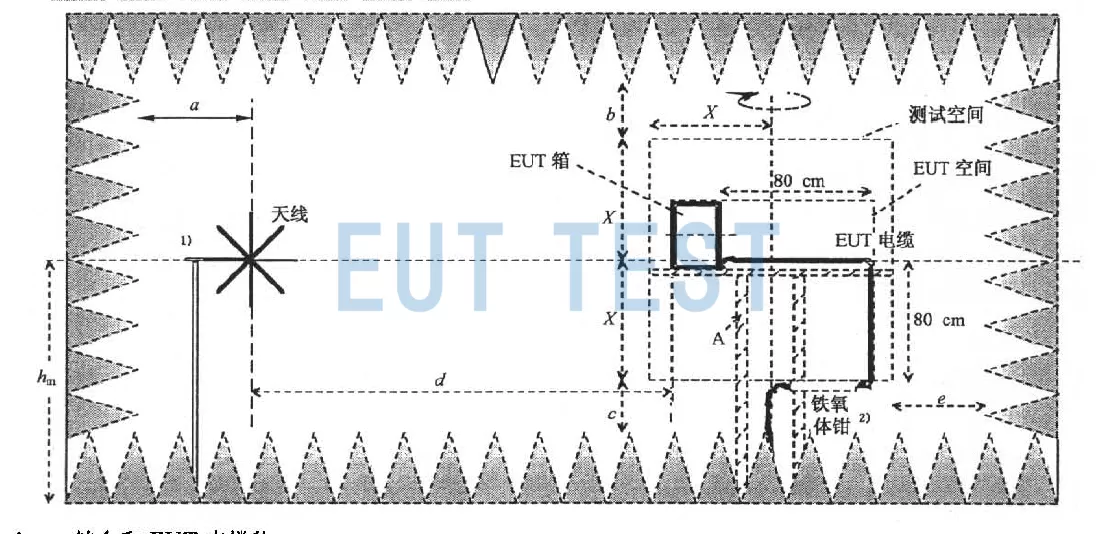
Typical test configuration diagram for far-field measurements
This also shows that the far-field using a fixed distance measurement makes up for the problem of non-repeatability of the near-field measurement. And practice shows that even if the distance of the antenna is not stable 1 meter method, for example, because of the installation, can not guarantee that the antenna measurement distance is absolutely 1 meter, may deviate from a few millimeters or even centimeters, then their measurement results are predictable changes, so the EMC measurement standard also takes this into account, so it gives some guidance on the measurement uncertainty.
The need for near-field measurements:
From a product certification perspective, near-field measurements don't need to exist. So why was the near-field probe invented? Here we simply say, when you use the far-field measurement to get a test data, we can see in the far-field measurement report part of the frequency point has more than or close to the limit line of the situation, however, just so, nothing else, you can not determine the frequency point of the interference level from the product where out? For EMC rectification engineers, this is the same as no way to start, but also may be questioned whether there is a problem with the measuring instrument, my product on the use of battery-powered, how can there be so much interference?
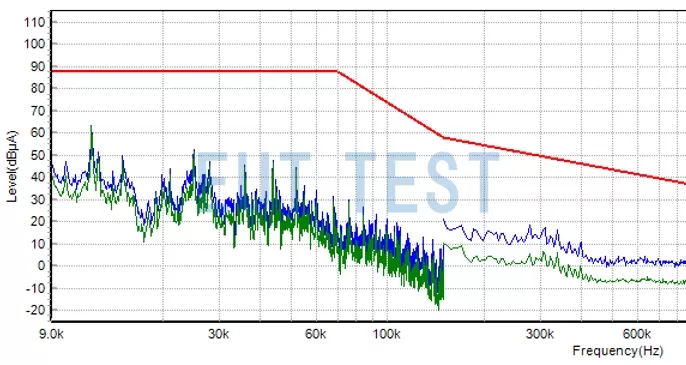
Far Field Measurement Data
To solve the above problem, we introduce the method of near-field probe measurements, that is, thenear-field measurementNear-field measurement is not a standardized test method. When we introduced the near-field measurement above, we mentioned that its disadvantage is that the distance is not fixed, resulting in the near-field test can not be used as a standard certification test method, but this is from another aspect instead of its advantages, for example, electronic products PCB has many components, the near-field probe can be farther away from these electronic components, can be closer, so that we can make the near-field probe in the PCB board surface arbitrary wandering This way we can let the near-field probe travel anywhere on the surface of the PCB and measure the interference level at different locations. You may say that the measurement distance how to do? We have also introduced the radiation interference level is logarithmically reduced with the increase in distance, so we can measure the greater value of the near distance, that is to say, as long as the far-field, the near-field can be measured, and the value of a larger and easier to measure.
When you use different resolution near-field probes according to EUTTEST's guidance to find the specific location of the radiated interference, together with some EMC rectification methods provided by us and your work experience, for EMC radiated emission exceeding the standard problem is not solved? This is why near-field measurements can replace far-field measurements.
Types of near-field probes:
After figuring out the above knowledge, we can learn how to choose the near-field probe, according to the principle of electromagnetic field, the radiation source is only electric field and magnetic field, so the near-field probe is divided into two kinds of electric field near-field probe and magnetic field near-field probe, it is important to note that the electric field and the magnetic field are mutually derived from each other and the propagation direction of the electric field and the magnetic field is perpendicularly orthogonal.
Does the near-field probe measure magnetic or electric fields?
Electric field near-field probes
The electric field near field probe can only measure the electric field, because it is using a single point or plane structure, so it can only receive the electric field perpendicular to the surface of the object to be measured, when there is an interference current flowing on the object to be measured, it will produce electric field lines in the vertical direction, according to the principle of physics, the interference current will gather charge around the wire, so that the electric field lines will always point from the high level to the low level.
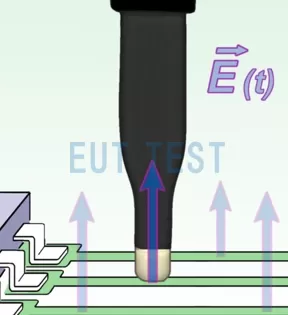
Principle of measurement of electric field near-field probes
Magnetic field near-field probe:
Magnetic field near-field probe can only measure the magnetic field, because it uses a ring structure, so it can only receive the magnetic field lines through the magnetic field ring, a typical magnetic field near-field probe measurement principle is shown below, the radiation source itself has an interference current, according to the right-hand rule, the energized wire will be around the presence of magnetic field lines, we only need to magnetic field near-field probe near the radiation source can be received in the following figure, the size of the magnetic field interference generated by the cable.
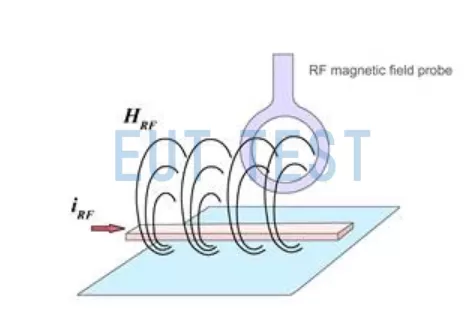
Measurement principle of the magnetic field near-field probe
After obtaining data from the near-field probe using a spectrum analyzer, we can use the following formula to calculate how much interference level is present on the radiation source.
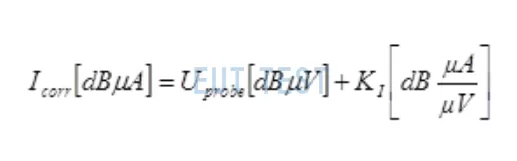
Interference level calculation formula for near-field measurements
How to choose a near-field probe:
We list the Near Field Probe products we sell in the EUTTEST website using the product categories, for details click on the link below to view:
Near Field Probe Product Selection
Measurement of radiated disturbances using near-field probes and oscilloscopes/spectrum analyzers
Summary:
Understanding the above knowledge points of how to choose a near-field probe, choose a near-field probe to measure the radiation interference is an economical and fast detection method, has now been recognized and used by the majority of hardware R & D design engineers and EMC engineers, the use of near-field measurements instead of far-field measurements, so that you can be at their desks can be resolved on the EMC problem.