
What is the sampling rate of an oscilloscope?
The analog-to-digital converter (ADC) of an oscilloscope converts an analog signal into a digital signal. This analog-to-digital conversion rate is called the "sampling rate". The sampling rate of an oscilloscope refers to the number of samples taken per second, and the unit is usually MS/s or GS/s. The higher the sampling rate, the more details of the signal can be captured.
How to select the desired oscilloscope sample rate?
There are many factors that affect the sample rate. The basic concept of sample rate, Nyquist's theorem, the selection of the actual multiplier, the effect of oscilloscope type, storage depth, bandwidth, application scenarios, and budgetary considerations are all factors that need to be taken into account when selecting the sample rate of an oscilloscope. The sample rate of an oscilloscope should be at least 2.5 times the bandwidth. For example, if the oscilloscope's bandwidth is 1.5 GHz, the sampling rate should be higher than 3.75 Gsample/s. Most digital oscilloscopes usually meet this minimum requirement. However, oscilloscopes may interleave multiple channels to provide the maximum sample rate.
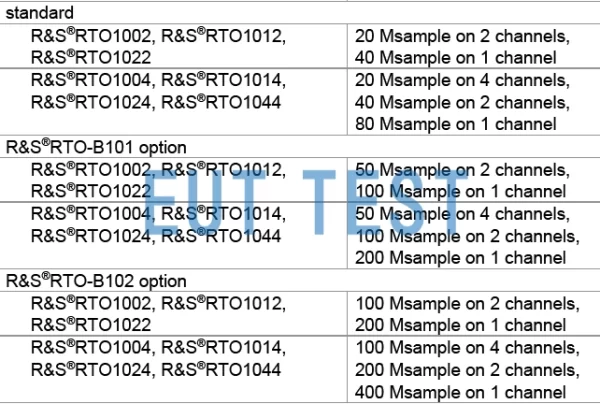
For example, 300 MHz, which is distributed by EUTTEST R&S OscilloscopesThe ®RTC1000 has a single-channel sample rate of 2 Gsample/s and a dual-channel sample rate of 1 Gsample/s. However, even with the reduced dual-channel sample rate of the R&S®RTC1000, the analog bandwidth is still more than 2.5 times that of the analog bandwidth!
In general, the larger the sampling rate the better
Selecting an oscilloscope's sample rate requires comprehensive consideration of signal characteristics, measurement needs, and oscilloscope performance, and the following are key steps and recommendations:
Determine the minimum sampling rate based on the highest frequency of the signal
- Nyquist sampling theorem (math.)Sampling rate (fs)fs) is at least the highest frequency of the signal (fmax) of the 2x(i.e., fs ≥ 2fmax), which otherwise leads to aliasing.
- Practical recommendations::
To ensure accurate reconstruction of the waveform details, it is common to choose the 5-10 times fmax. Example:- surveying 100MHz sinusoidal signalThe theoretical minimum sampling rate is 200MS/sbut the actual recommendation is to choose 1GS/s(i.e. 10 times).
- For fast edge signals (e.g. digital pulses), the effective frequency is calculated from the signal rise time (tr).
f≈0.35/tr≈0.35
and select the sampling rate accordingly.
Effect of Oscilloscope Type
- Real-Time Sampling::
Suitable for single or non-repeating signals where the sampling rate needs to be met throughout (e.g. to capture transient events). - Equivalent-Time Sampling::
Applicable only to periodic repetitive signals. Reconstruction of the waveform by multiple samples reduces the real-time sampling rate requirement.
Memory Depth Tradeoffs
- Depth of storage = Sample rate × Time window.
If you need to capture signals for a long period of time (e.g., to analyze protocol packets), you need to balance the depth of storage with the sampling rate:- High sample rate + long capture time → great memory depth required, which may otherwise be forced to reduce the sampling rate.
- For example, a 10ms time window at 1GS/s sampling rate requires a storage depth of 1G/s x 0.01s = 10Mpoints.
Matching bandwidth to sampling rate
- Oscilloscope Bandwidthshould be higher than the highest signal frequency (typically bandwidth ≥ 1.5 times the signal frequency).
take note of: When the bandwidth is insufficient, the high-frequency signal is attenuated even if the sampling rate is high.
Examples of specific application scenarios
- Digital signals (e.g. SPI, I2C)::
The sampling rate needs to be sufficient to capture the shortest pulse or rise time. For example, for a signal with rise time tr=1ns and effective frequency fedge=350MHz, a sampling rate of ≥3.5GS/s is recommended. - Power Supply Noise Measurement::
Concerned about low-frequency ripple and high-frequency noise, the sampling rate typically needs to be ≥100MS/s. - RF signals (e.g. 50MHz carrier + modulation)::
Higher sampling rates may be required depending on modulation bandwidth expansion requirements.
Balancing budget and performance
- High sample rate oscilloscopes are expensive, and cost-effective solutions need to be selected based on actual needs. For example:
- Debugging low-frequency control signals (≤20MHz), 500MS/s sampling rate is sufficient.
- Analyze high-speed serial buses (e.g., USB 3.0), which need to be ≥5GS/s.
Summary: Steps for selecting the sample rate of an oscilloscope
- Determines the maximum frequency or rise time of the signal.
- Calculate the minimum sampling rate (≥5 times fmax or meet rise time resolution).
- Check that the oscilloscope bandwidth matches.
- Adjust the sampling rate and time window according to the storage depth requirement.
- Select the final program in conjunction with the actual application and budget.
Example formula::
For signals with rise time tr, the sampling interval should be ≤ tr/10, then the sampling rate:
fs≥10/tr
Through the above steps, you can efficiently select the appropriate oscilloscope sample rate to avoid data distortion or waste of resources.
The oscilloscope offers different acquisition modes, such as Peak Detect or High Resolution. In these modes, the ADC can continue to operate at the maximum sample rate, but the number of data points stored in memory is reduced. These modes provide higher sample rates for applications with relatively slow signal rates.
 How to use oscilloscopes and near-field probes for EMI diagnostics