Introduction:
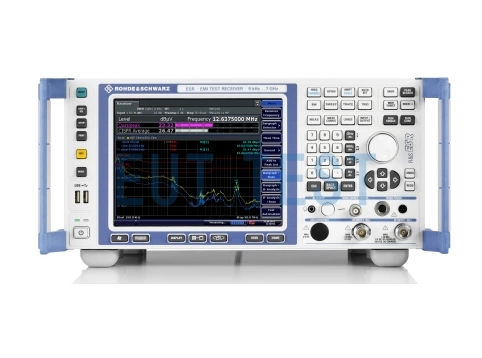
EMC test receiver is a kind of test instrument for measuring electromagnetic compatibility, which is generally used to test radio emission test, including nuisance voltage, nuisance current, nuisance power or nuisance field strength and other test items. Below you will learn about the impulse response characteristics, IF bandwidth and other basic indicators of EMI receivers, and learn how to go about purchasing the right EMC test receiver for you.
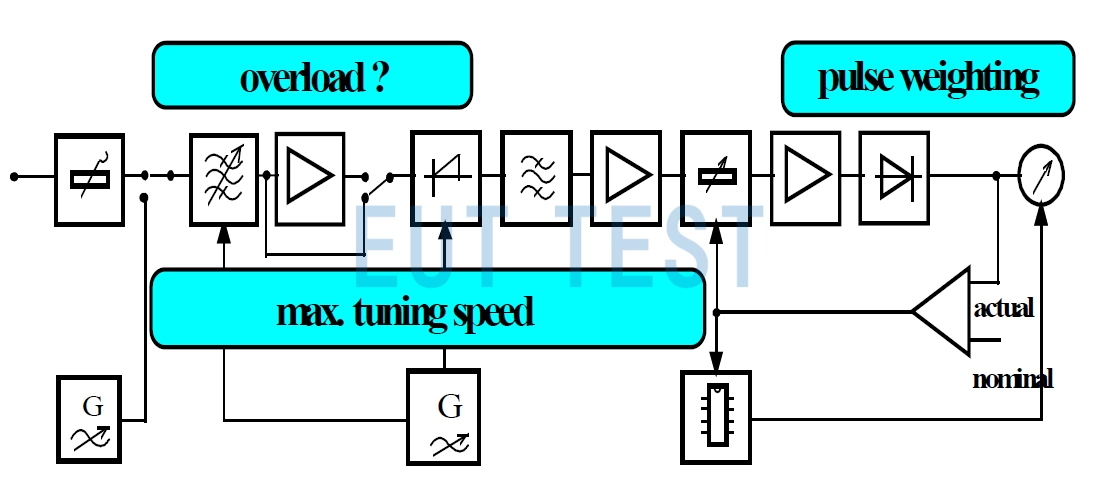
EMI Test Receiver Working Principle Diagram
EMC Test Receiver Classification:
quasi-peak measurement receiver
The following parameters are required for a Quasi-Peak (QP) measurement receiver according to the CISPR16 standard requirements:
- Requires the receiver to be equipped with a quasi-peak detector
- Amplitude measurement accuracy less than 2dB
- Frequency range covered (as per CISPR standards)
- CISPR BAND A : 9k~150kHz
- CISPR BAND B : 150k~30MHz
- CISPR BAND C : 30M~300MHz
- CISPR BAND D : 300M~1000MHz
impulse response
The receiver's amplitude versus frequency fully meets the requirements of CISPR 16-1, and the IGUU 2918 can be configured to periodically measure the receiver's impulse response characteristics if necessary.
Measuring the impulse response of a receiver requires the completion of two tests: amplitude relationship (absolute calibration) and variation with repetition frequency (relative calibration). For details, please see IGUU 2918 Calibrating Impulse ResponseThe product information.
selectiveness
As shown in the figure below, the IF bandwidth of the test receiver is defined as 6dB bandwidth, which is divided into four different reference bandwidths and test frequency ranges of 200Hz, 9kHz, 120kHz and 1MHz.
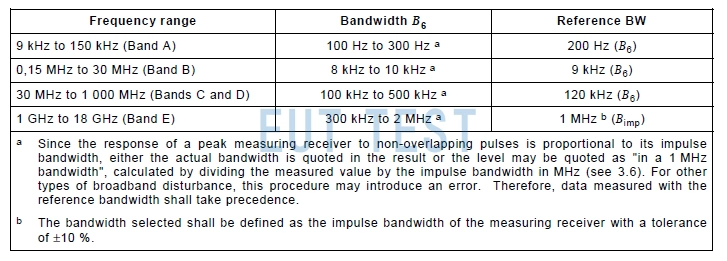
CISPR16 Required 6dB Bandwidth for Test Receivers
Regarding the bandwidth of test receivers, the requirements are slightly different in commercial, civilian, and military standards, etc. You can check the following two tables to compare their specific differences before deciding how to buy test receivers.
Commercial standard measurements of optional receiver IF bandwidth:
“Reminder: swipe tables left and right”To summarize, EUTTEST recommends that you use the following products for commercial and residential standard testing.R&S ESR,ESRPReceiver models such as EPL, ESCI, ESPI, etc. Note that some models are pre-certified level, please contact us for more information by providing us with your detailed requirements.
Military standard measurements of optional receiver IF bandwidth:
“Reminder: swipe tables left and right”In summary, EUTTEST recommends that you use the R&S ESW test receiver for military standard testing.
Other types of EMC measurement receivers
CISPR16-1 standard states that if the customer uses a peak detector, average detector or rms detector receiver can also be used for EMI measurements, however, these types of receivers still need to be completed and quasi-peak receivers and quasi-peak receivers as the amplitude of the relationship between the (absolute calibration) and with the change in frequency of the repetition of the (relative calibration) two tests, see the above for more details and will not be repeated description.
Intermittent harassment of receivers:
Intermittent Harassment is also called the Khartoum test, for more information see "Intermittent harassment and clicking"
Summary:
All the detectors or receivers for intermittent nuisance measurements, spectrum analyzers, etc. described above can be used for EMI compliance measurements as long as they are based on FFT measurements. However, if you want to do EMC certification testing, you need to select the correct detector according to the actual product standard requirements, and then just select the receiver model according to the detector type.
for example GB 4343.1-2024 Standard Detailed RequirementsConducted emissions, radiated emissions are proposed to limit the requirements of the table, as shown in the figure below, then you can see in the table that both tests need to measure the quasi-peak and average value, then we should choose to use at the same time contains quasi-peak and average value detector receiver to test our products.
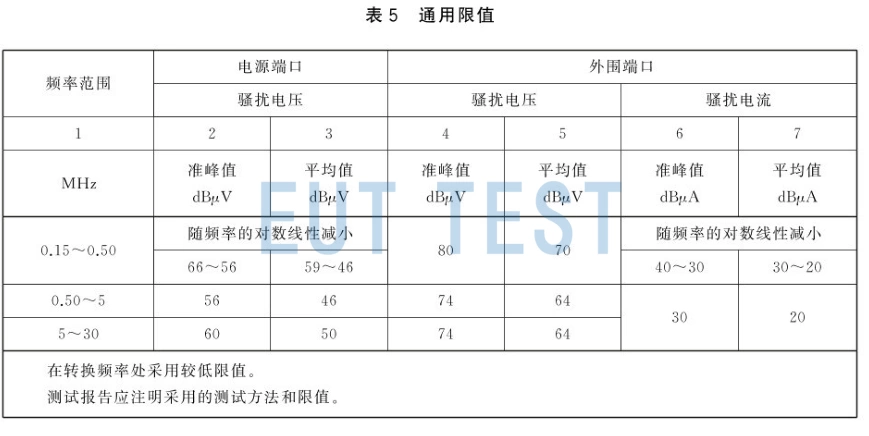
GB4343.1-2024 requires test receivers to measure both quasi-peak and average values.
 GJB151B-2013 Performance Requirements for Receivers and Signal Generators
 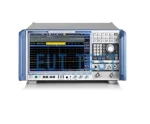 R&S EMI Test Receiver Operator's Guide and Field Q&A Transcripts