
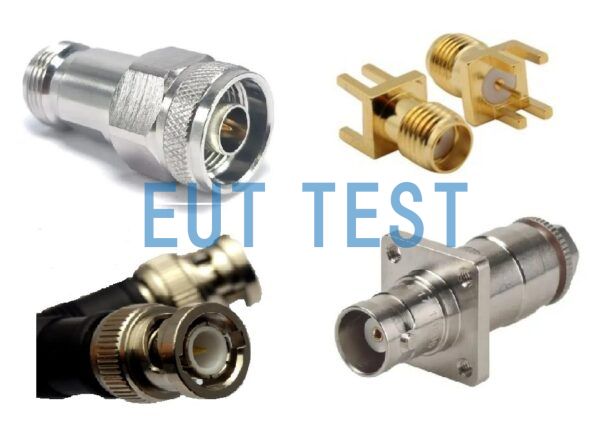
Introduction:
RF connector is a coaxial cable used to connect the ends of the adapter fittings, in the selection of connectors, you are connected according to the RF cable impedance to choose the same impedance of the connector, in addition to considering the choice of different connector styles to complete the transmission of RF signals and conversion. From the following RF connector basics to learn how to choose the right RF connector for your use.
History of RF connectors:
- The UHF connector, which appeared in 1939, was the first RF connector;
- With the development of radar, radio and microwave communications during World War II, medium-sized connectors such as N,C, BNC, TNC, etc. were developed.
- After 1958, with the miniaturization of the whole equipment, miniaturized products such as SMA, SMB, and SMC appeared;
- The U.S. Military Standard MIL-C-39012, General Specification for RF Coaxial Connectors, was developed in 1964;
- In the late seventies, millimeter wave connectors appeared;
- In the early nineties, HP introduced 1.0mm connectors for frequencies up to 110GHz and used them in their instrumentation;
- Surface mount RF coaxial connectors appeared in the nineties and were used in a large number of cellular phone products;
- China from the fifties began to develop RF connectors by the OEM;
- Specialized factories were formed at the end of the 1960s and specialized production began;
- In 1972, the State organized a centralized design, so that the domestic RF connectors are self-contained system and can only be used domestically.
- Low level of product standards and inability to interface and interchange with international common products;
- Since the 1980s, international standards have been adopted, and GB11313 and MIL-C-39012 have been issued in accordance with IEC169 and MIL-C-39012.
- GJB681, so that the production and use of RF coaxial connectors gradually with international standards.
- After decades of efforts, the overall level of general RF connectors and foreign gaps, but the design and production of precision connectors and foreign countries still have a large gap;
Basic Uses:
RF coaxial connectors are used to transmit RF signals over a wide range of frequencies up to 18 GHz or higher, and are mainly used for RF testing, EMC testing, OTA testing, radar, communications, equipment panel mounting, data transmission, and aerospace equipment communication applications.
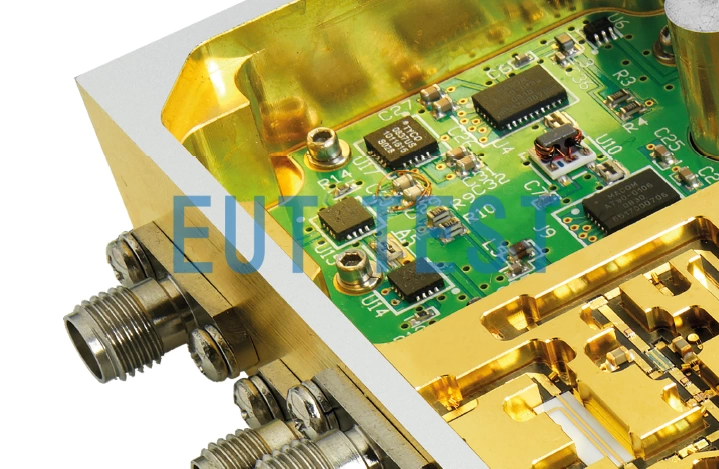
RF coaxial connector mounted on the equipment panel
Basic structure:
The basic structure of an RF coaxial connector consists of: the center conductor (the positive or negative center contact); the dielectric material, or insulator, outside the inner conductor; and the outermost part is the outer contact, which plays the same role as the outer shield of a coaxial cable, i.e., transmits signals, serves as a shield, or as a grounding element for the circuit.
Test standards related to RF connectors:
- U.S. Army Standard and other advanced standards:The United States is the world's largest manufacturer and consumer of general-purpose RF connectors, and its level of excellence, so the U.S. military standard MIL-C-39012 is considered to be the highest standard for RF connectors;
- IEC standards:The IEC is a guidance standard, not a mandatory standard, and is therefore rarely applied directly;
- DIN of Germany, BS of England, JIS of Japan:Most of these countries standards are developed with reference to or equivalent to the U.S. military standard, and some countries even directly apply the U.S. military standard, and no longer formulate separate standards; It is worth mentioning that Germany has some advantages in some special new connectors, such as: DIN47223 7/16 (L29) series, DIN47297 SAA series and DIN41626 DSA series and so on. These products are widely used in the field of communications, German standards and products have been recognized around the world, but the United States has not yet appeared in the corresponding standards.
- Our current general RF coaxial connector standard is divided into two parts:
- Military standard. DJB681 , GJB680 , GJB976 and detailed specifications;
- Civilian product standards. GB11313 according to IEC169-1.
Whether it is the national military standard or the national standard, basically in accordance with the move of foreign advanced to the development of standards, therefore, it can be said that China's current standards and international standards, and indicators and technical level with the international advanced level synchronization.
Classification:
RF connectors are categorized in many ways, and you can learn how to choose the right connector in different categories by following the layout order of this article.
Male and female heads:
Common coaxial RF connectors have a distinction between male and female connectors, which is a characteristic of all classified connectors.
“Reminder: swipe tables left and right”
Connectors - male - international marking: Male
Female connector - international marking: Female
Other mounting connector shapes:
In addition to the above introduction of male and female connectors, in the actual production of the application according to different installation locations, you will find that the male and female connectors also have a lot of connector shapes as shown in the table below.
“Reminder: swipe tables left and right”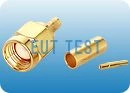
Inverse joints - international marking: PR
(e.g. SMA FEMALE BULKHEAD)
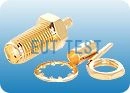
Lockable Fittings-International Marking: Bulkhead
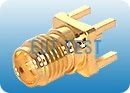
PCB connectors - international common marking: PCB
(e.g. SMA PANEL MOUNT) Usually there are 4 holes and 2 holes.
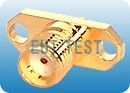
Fittings with screw holes - international marking: Panel
Types of RF connectors:
There are already many kinds of connector types in the current market, which have their own impedance and shapes, but they also need to be manufactured using the basic connector shapes introduced in the previous section, but this type of introduction is not the same as the introduction in the previous section.
Categorized by the way the connector is connected:
- Bayonet type (inner bayonet, outer bayonet): BNC
- Threaded (right-hand thread, left-hand thread, male thread, female thread) (Y): L29-7/16 , N , F , TNC , SMA , SMC , SSMA , SSMB , FME , L9(1.6/5.6) , 7mm , 3.5mm , 2.4mm , K(2.92mm) , 1.85mm , 1mm .
- Push-in (inline, self-locking): SMB , SSMB , MCX , MMCX , SMP , SMI , BMA , SAA .
- Flange connection type (F): Most of the above can be manufactured in flange form.
- Welded: Most of the above can be manufactured in welded form. (This depends on demand)
- Board-to-board connection: Used to connect two PCB circuit boards.
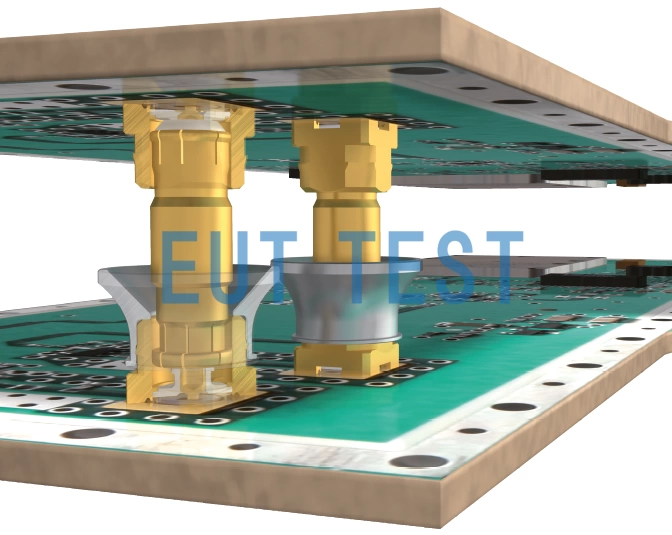
RF connectors for board-to-board connection forms
Basic knowledge: For wireless RF test application, usually the connector on the equipment side is female male thread, and the cable side is male female thread.
Categorized by connector size:
- Standard: UHF , N , 7/16 , 7mm;
- Small: BNC, TNC.
- Subminiature: SMA, SMB , SMC , MCX , BMA , SAA , 3.5mm.
- Micro: SSMA , SSMB , MMCX , 2.4mm , K(2.92mm) , 1.85mm , 1mm.
Classified according to the characteristic impedance of the connector:
- 50Ω
- 75Ω
Categorized by the bending angle of the connector:
- Straight: A common type of connector is straight.
- Elbow (W): The connector is at an angle to the mounting cable, such as 90 degrees as shown in the figure below.
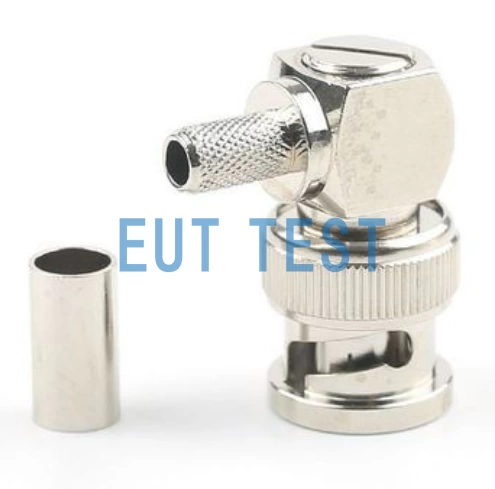
90 degree elbow connector
Common transmission cables RF connectors and connectors:
After understanding the different types of connectors and classification of RF connectors, we look at several commonly used RF connectors in detail and related parameters.
“Reminder: swipe tables left and right”footpath
(L29)
(Diameter 7mm)
Mobile Communication Patchcord Connection
Microwave communication system main feeder cable connection
High power RF signal transmission
15GHz (75 Ω)
DIN 41626
18 GHz (semi-rigid).
(not intermatching with 50Ω in most cases)
Compatible with 3.5mm and SMA connectors;
Compatible with 1.85mm connectors.
2GHz (75Ω)
Electrical components, instrumentation, transmission systems.
wireless communication systems.
Telecom system with 75Ω version
Personal Computer Memory Card (PCMC11′-Card, Cable Assembly.
As can be seen from the above introduction, learning and understanding the basics of common RF connectors for for engineering RF personnel is very important, the next step is to look at what you can buy imported and domestic RF connectors.
How to buy RF connectors:
We are the agent of AOEMC and Switzerland huber+suhner RF coaxial connector products, through the above knowledge to choose the type of connector you need, and then contact us to get a quote.
In addition, RF connectors are used to connect RF cables, and we also provide RF cables and coaxial cables of related brands.
Coaxial cable recommendations:
Our company also sells coaxial cables imported from German schwarzbeck company, please press the frequency range you need to test from the following coaxial cables first:
Selecting the right modelAnd thenProvide cable length and connector type to EUTTEST. Get quotes and lead times from our sales staff.;
We only offer new imported coaxial cables, no used goods or defective products.
 RF Cable Basics
  RF Attenuator Basics
 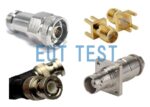 RF Adapters & RF Connectors Basic Knowledge Popularization