

The HT9464 and HT-9464M, both of which are sold by our company, can fulfill the Viso withstand isolation voltage and Viotm maximum transient isolation voltage tests. This article mainly introduces the definition of Viso and Viotm test indexes, the origin of the name, the test method and the difference between the two different test methods.
Definition:
Viso - Withstand Isolation Voltage - The maximum AC root mean square (RMS) isolation voltage that the isolator can handle for one minute without breakdown.
Viotm - Maximum Transient Isolation Voltage - A manufacturer-specified peak isolation voltage that characterizes the specified tolerance of its isolation against a one-minute transient overvoltage.
Define the source:
Withstand isolation voltage Viso from UL 1577Standard, max. transient isolation voltage Viotm from IEC 60747-17 (VDE 0884-17) standard. The figure below shows the test requirements for Viso and Viotm for a particular digital isolator.

Test requirements for Viso and Viotm for a digital isolator
How do I test Viso to withstand isolation voltage?
- For qualification testing, use our HT9464 or HT-9464M to verify withstand isolation voltage by applying sinusoidal stress for 60 seconds at the claimed withstand voltage value.
- During production testing, applying 1.2* V ISOof sinusoidal stress for one second.
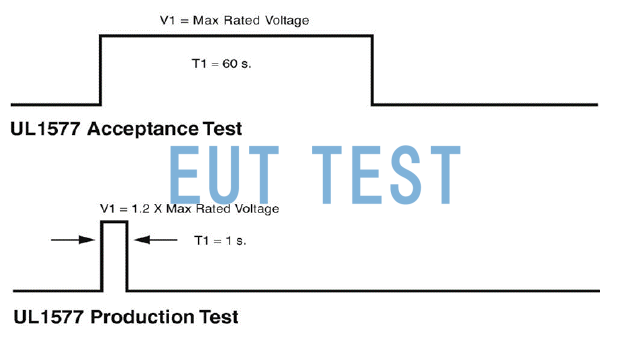
UL1577 Conformity and Production Test Demand Voltage and Test Time

HT-9464M can set the test voltage and time according to the standard requirements.
How do I test the Viotm maximum transient isolation voltage?
The maximum transient isolation voltage is respectively passed through the HT9464 maybe HT-9464M Conduct “method a” testing and “method b” test validation for qualification and production testing.

HT9464 or HT-9464M Verification of “method a” testing and “method b” testing
Why are these tests important?
Events such as arcing on the power supply or load changes may cause voltages to appear on the isolator well above the expected operating voltage. It is important that the isolator is not damaged during these brief high voltage events. The isolator should be able to withstand a brief voltage increase and continue to operate normally after the expected operating voltage is restored. The withstand voltage Viso quantifies the maximum RMS voltage that the isolator can support for 60 seconds, and the maximum transient isolation voltage Viotm quantifies the maximum peak voltage that the isolator can support for 60 seconds.
Difference between Viso and Viotm:
The main difference between the Withstand Isolation Voltage Viso and the Transient Isolation Voltage Viotm is the unit used to define the specifications. The withstand isolation voltage is defined as the RMS voltage value, while the maximum transient isolation voltage is defined as the peak value. For sinusoidal stresses, the isolation withstand voltage is usually the same as the maximum transient isolation voltage.